The First Parenting Variable ...Your Child
Why Children are different

One cold February morning in the early 1980s, I began my pediatric practice day with a six-month-old checkup. Entering the quiet exam room, both parents were beaming at their cooing child. Everything was wonderful: he was “so good,” sleeping through the night and on a regular schedule. Both parents were patting themselves on the back for their fine parenting skills. When I entered the next appointment room, also for a six-month checkup, I found the baby girl screaming on the treatment table and her mother in the corner, with her tears and mascara sliding down her face, lamenting that she was a failure as a parent because her daughter seemed to cry all the time.
Why are the parents of some infants so relaxed and at ease, while others are exhausted, guilty, and frustrated with raising their child?
Is it because of their parenting skills, or is it due to something else?
Why do some children:
· Move constantly, while others are content to sit quietly and play?
· Sleep and eat in regular patterns, while others never settle into any routine of hunger or rest?
· Resist change, while others go with the flow?
· Thrive in new situations, while others are shy, cautious, or fearful?
· Focus on one task with determination, while other children jump from one to another?
· Obey quickly, while others immediately resist your requests?
· Laugh and cry with gusto, while others just smile or whimper?*
*From the 4th chapter of: The Normal but Not-So-Easy Child: Raising Your Child without Frustration, Anger, or Guilt.
These are some examples of temperament trait differences. Temperament is a natural part of a child’s personality; it is the genetic imprint your child inherits half from mom and half from dad.
When you buy a new phone, you unwrap it, take it out of the box, and turn it on. It already comes pre-programmed with computer code and default settings. It is operational right out of the box.
Babies come that way too.
Children arrive pre-programmed with genetic code and default behavioral settings already in place at birth. The major difference is this:
New phones are manufactured with essentially the same default settings.
Children are not.
Every child—except identical twins—has unique DNA. Their default behavioral and learning settings are expressed through what we call temperament traits. Each child is unique.
These traits influence:
Activity level
Flexibility to change
Acceptance of new experiences
Sensory sensitivity and information gathering
Persistence
Distractibility
Intensity/reactivity
Mood
(New York Longitudinal Study — NYLS)
These temperament traits develop the foundational building blocks for development of executive function processes.
Two child psychiatrists, Drs. Stella Chess and Alexander Thomas, identified and mapped these nine traits in infants and then tracked a large group of these infants for thirty years. The New York Longitudinal Study is the longest study of its kind and discovered that we are not born a blank slate, but rather with inherited characteristics from our parents. This was controversial until the past twenty years of behavioral genetic research that shows that 60% of behavior is driven by genetics and the other half is influenced by it. Parents are important but genetics sets the floorplan.
Like other genetically influenced traits—eye color, facial structure, or skin tone—temperament does not fundamentally change. Maturity, learning, and environment shape how traits are expressed, but the underlying wiring remains relatively stable across life.
Once you understand this, it becomes much easier to see why children respond so differently to the same event, environment, or parenting strategy:
They are wired differently.
It is also why parenting style alone is not enough to explain successful parenting outcomes. A single parenting approach would only work consistently if all children responded alike.
Children start life with a predetermined set of personality traits. That sounds sort of scary, but it’s really a blessing that we can measure, understand, and predict what makes your child tick this early in life.
Everyone has the same temperament traits but at different degrees. That’s what makes interpersonal connections interesting.
An example of a temperament trait is Activity level. The range of activity is for this explaination 0 to 100 and fitting a bell-shaped curve. At one end of the curve is the very inactive child(Score 10); at the other the very active child(Score 90). The middle is the midactive child(Score 50).
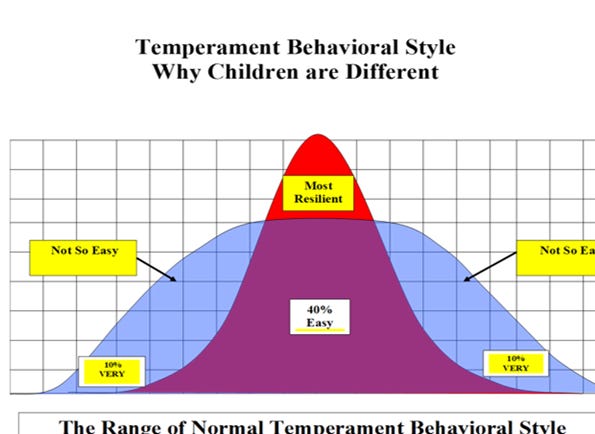
Your child’s genetic temperament traits are the first of the four variables that determine the ease or struggles of raising your child.
There has been a change over the past fifty years from “raising our children” to “parenting.” Currently, parenting style is the focus: gentle, authoritative, attachment, connective, etc. This focuses on the parent’s actions. No parenting style works all the time because it has only a single focus. It fails much more that is succeeds, but many parents continue struggling with an attempt to make this one variable work.
Over forty years of pediatric and behavioral pediatric practice experience has reinforced the four variables that must be considered in raising our kids:
1. Your child’s temperament
2. The parent’s temperament
3. The fit of child/parent temperament traits
4. The circumstance of the moment
Come with me on these posts of It Depends on the four variables to understand why some children require more time, energy, patience, and skill for their successful growth.
Thirty percent of children are very easy, thirty percent are Not-So-Easy (NSE), and the rest are, at times, a challenge. This understanding is the first step in predicting whether your child and you will struggle or not. When misbehavior intersects your day the starting point to understanding is always your child’s temperament. This leads to a beter outcome than quessing; “What do I do next?’
Next post will explore how children are easy or not. You will have the opportunity to take a one minute test to determine if your child is easy or Not-So-Easy and to what degree.
Raising children Depends on reproducible variables that are explainable, understandable and actionable.
Until next time.
Feel free to like, restack and share.
Dr. Bob